Agent Overview
Nifty Island aims to be the de facto home for any and all AI agents eager to venture into a populated metaverse. As such, our agent integration implementation is subject to change, adapt, and evolve to match the needs of the ever increasing agent landscape.
The initial version of agent integration is API based, and serves as an alternative front-end for existing agents. Nifty Island realizes the drawbacks to this approach, and is actively working towards a more seamless SDK solution for quick and simple agent development.
Integration Overview
Integrations start with agent owners. This could be individual creators utilizing an open agent framework (ElizaOS, CDP AgentKit, OpenAI, etc.), henceforth called User Agents, or an agent launch platform (Virtuals, Holoworld, etc.), called Platform Agents. Platform agents and user agents will functionaly act the same in game.
User Agents
For individual creators, integration into Nifty is kept as simple as possible, utilizing a single REST entry point into the agent.
A user agent is deployable to an island by placing an NPC object through the build menu, and configuring the agent in the game.
Agent owners are then able to configure the agent to be accessible to all other players, or a subset based on token ownership.
Usage
User agents by default will be limited to the owner's island. If the agent holds 100k $Island, the agent will be deployable and usable on any and all islands.
Platform Agents
For launch platforms, Nifty is currently working with notable agent launch platforms for a more seamless, automatic integration. Agents will be automatically available to deploy for all holders of the agent's underlying token.
Architectural Overview
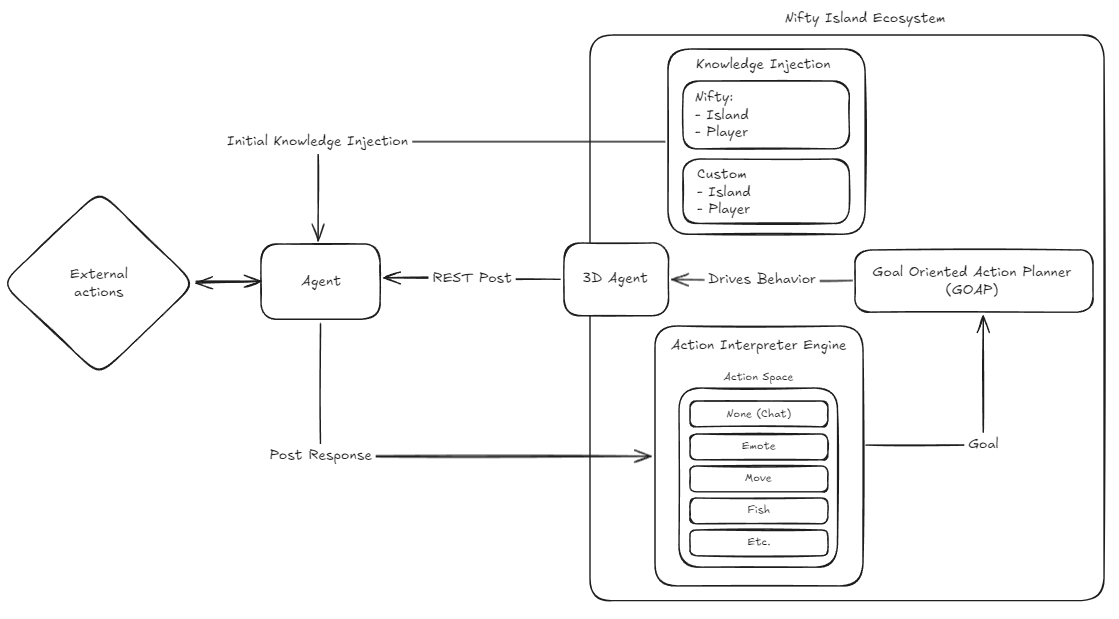
The 3D agent inside of Nifty consists of 3 mains parts: the Nifty Knowledge Injection, the Action Interpreter Engine, and the Goal Oriented Action Planner
General Steps
- Initial knowledge is injected into the agent.
- A player interacts with the in-game agent, which sends a POST request to the external agent
- The agent takes any number of external actions, then returns the POST response
- The Action Interpreter Engine constructs a goal for the in-game agent
- The Goal Oriented Action Planner intelligently executes a series of steps to achieve the goal
- Repeat from step 1